Will Artificial Intelligence Curb or Turbocharge Disinformation Online?
Event date
This symposium was hosted by CFR on November 14, 2018. “Will Artificial Intelligence Curb or Turbocharge Disinformation Online?” convened policymakers, business executives, and other opinion leaders for a candid analysis of artificial intelligence’s effect on democratic decision-making.
Session I: Moderating Online Content with the Help of Artificial Intelligence
Speakers
- Robyn CaplanResearcher, Data & Society
- Tiffany LiResident Fellow, Yale Law School
- Sarah RobertsAssistant Professor of Information Studies, UCLA
Presider
- Joel T. MeyerVice President of Federal and Corporate Markets, Predata
Transcript
This panel examines AI’s role in moderating online content, and its effectiveness, particularly with respect to disinformation campaigns.
SEGAL: (In progress)—real, I am not a deep-fake hologram—(laughter)—unless I say something wrong, and then I was totally manipulated and it was all fake news.
I just want to welcome you all to today’s program. This is the fifth symposium we’ve done, building on last year’s, which was on Russian election interference and securing the election infrastructure.
Please take a look at other Council products. Net Politics, we’ve covered a number of these issues. And last month, we published a great cyber brief by Bobby Chesney and Danielle Citron on deep fakes—Bobby’s going to be on the following panel—so hopefully you guys will take a look at that.
And I want to thank the D.C. staff, Katie Mudrick, Marisa Shannon, and Stacey LaFollette, and Meghan Studer, for helping us out. And on the New York digital side, Alex Grigsby, who helped put everyone together for these conferences.
I think great timing, you know, just a week after the election. The evidence, I think, on what we saw is pretty mixed. Some success from the companies on takedowns, but clearly, lots of disinformation...
Session II: Deep Fakes and the Next Generation of Influence Operations
Speakers
- Robert M. ChesneyProfessor of Law, University of Texas School of Law
- Aviv OvadyaChief Technologist, University of Michigan
- Laura M. RosenbergerDirector and Senior Fellow, German Marshall Fund of the United States
Presider
- Guillermo S. ChristensenPartner, Brown Rudnick LLP
Transcript
This panel identifies guidelines tech companies can follow to limit their negative use and offer views on how governments should react to deep fakes, if at all.
CHRISTENSEN: Well, good morning, everyone, and welcome to our second panel of today. The topic is “Deep Fakes and the Next Generation of Influence Operations.” I think with deep fakes we’re into some very new territory for the Council and we’ll talk a little bit about a lot of very interesting issues.
First, let me introduce the panel that we have. Next to me is Bobby Chesney. Among other things, he is the blogger and chief editor, I think, of Lawfare.
CHESNEY: Ben Wittes is chief editor. Me, just a lackey.
CHRISTENSEN: Just one of the lackeys. OK. Then Aviv Ovadya, who is formerly the chief technologist with the—
OVADYA: Center for Social Media.
CHRISTENSEN: —Center for Social (Media) Responsibility but is now the founder for Thoughtful—the Thoughtful Technology Project, and we might hear a little bit more about that. And then to my far right, Laura Rosenberg (sic; Rosenberger), who’s with the German Marshall Foundation (sic; Fund).
So a couple of reminders before we start. This is an on-the-record discussion. My...
Session III: Keynote Session with Richard H. Ledgett Jr.
Speaker
- Richard H. LedgettSenior Advisor, Hakluyt & Company
Presider
- Judy WoodruffAnchor and Managing Editor, PBS NewsHour
Transcript
This symposium convenes policymakers, business executives, and other opinion leaders for a candid analysis of artificial intelligence’s effect on democratic decision-making. The symposium is timely as countries such as China, France, Germany, the United Kingdom, and the United States rush to invest in artificial intelligence to solve cybersecurity challenges and stem the spread of disinformation online.
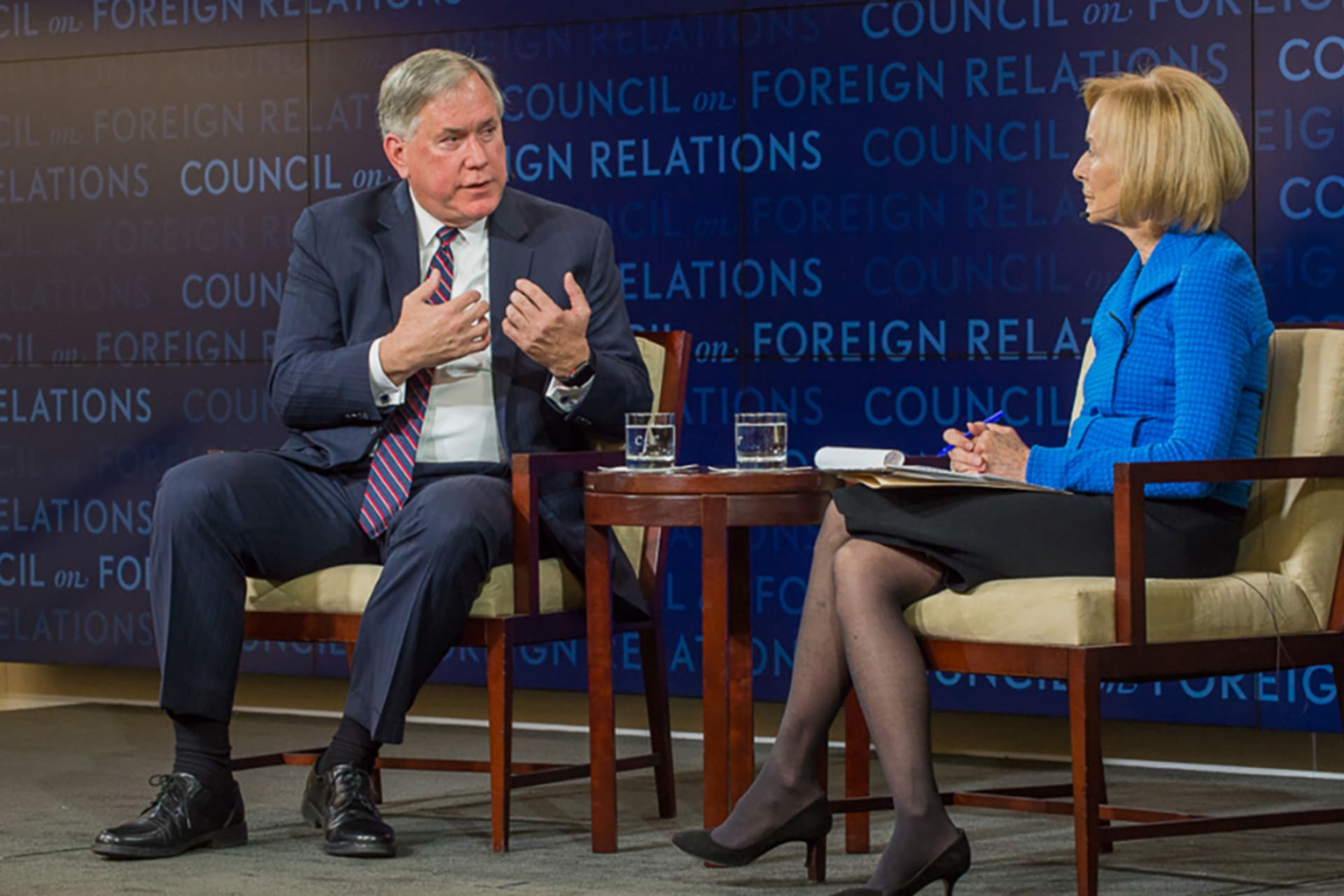
WOODRUFF: Hello, everyone, and welcome to this—I guess the final part of your—of your morning symposium. And this part of it is with Richard Ledgett. I’m Judy Woodruff, the anchor and managing editor of the PBS NewsHour. I’m going to be moderating the discussion. I think both of us acknowledge that we have the disadvantage of not having sat in on your morning conversation. So we recognize there may be some things that came up in those—in those discussions that you’ll want to bring up when we turn it over to you for questions. So please feel free to do that.
I just want to say at the outset I’m glad to be here to talk about—really, to help facilitate this important—what is more important than preserving the health of our democracy. And that really is what we’re talking about, as we face growing...